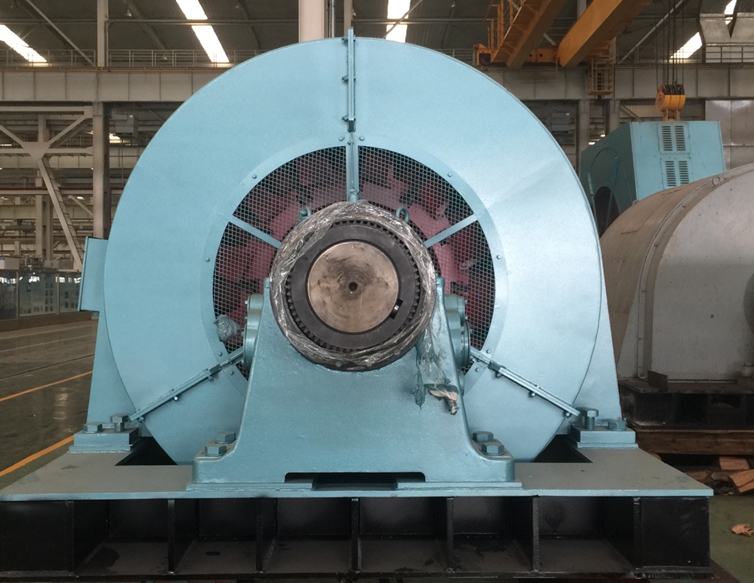
Synchronous motors are mainly used for constant-speed, high-power, high-efficiency, precision, and power-factor-correction applications. I commonly see them specified for compressors, pumps, fans, ball mills, crushers, rolling mills, paper machinery, conveyors, mining equipment, industrial drives, and electric vehicles. Their value is greatest when the motor must maintain a precise speed under changing load or support the electrical performance of an industrial facility.
!
A synchronous motor is an AC motor whose rotor rotates at the same speed as the rotating magnetic field produced by the stator. Unlike an induction motor, it does not normally operate with continuous slip between the rotor and stator fields. The relationship between frequency, pole count, and speed is expressed as synchronous speed: Ns = 120f/P, where Ns is speed in revolutions per minute, f is supply frequency in hertz, and P is the number of poles.
For example, a four-pole motor supplied at 50 Hz has a synchronous speed of 1,500 rpm, while the same motor supplied at 60 Hz has a synchronous speed of 1,800 rpm. The rotor must be brought close to this speed before it can lock into synchronism. Depending on the design, the rotor may use field windings supplied with DC excitation, permanent magnets, or a combination of damper and excitation systems.
I divide synchronous motors into three practical groups: wound-field synchronous motors, permanent magnet synchronous motors, and reluctance-based synchronous motors. Wound-field units are often selected for large industrial loads and power-factor correction because their excitation can be adjusted. Permanent magnet synchronous motors are common where compact size, high efficiency, and variable-speed control are priorities.
The stator receives three-phase AC power and creates a rotating magnetic field. The rotor produces its own magnetic field through DC excitation or permanent magnets, and this rotor field aligns with the rotating stator field. Once synchronized, the rotor turns at the electrical field speed rather than slowing slightly as load torque increases.
Synchronous motors usually require a starting method because a stationary rotor cannot immediately follow the rapidly rotating stator field. Common starting arrangements include damper windings, an auxiliary induction motor, a reduced-frequency variable frequency drive, or a separate starting system. A VFD can gradually increase frequency from a low value, allowing the rotor to accelerate while maintaining magnetic alignment.
The motor’s torque angle changes as mechanical load changes. If the load increases within the motor’s pull-out torque limit, the rotor remains synchronized and develops additional torque. If the load exceeds that limit, the motor may fall out of synchronism, causing vibration, current fluctuations, and possible protective trips.
The most common synchronous motor applications involve large, continuous-duty loads that benefit from constant speed, high efficiency, adjustable power factor, or precise speed control. I evaluate the driven machine first, because the correct motor type depends on starting torque, load variation, operating speed, duty cycle, environmental conditions, and available electrical controls.
Synchronous motors are widely used for reciprocating, centrifugal, and screw compressors in chemical plants, refineries, gas-processing facilities, and industrial refrigeration systems. Compressor trains often operate for long periods at relatively stable speed, making the motor’s fixed-speed operation suitable for continuous production. A wound-field motor can also operate at a leading power factor, helping offset the reactive power consumed by other facility loads.
For a compressor application, I check starting torque, acceleration time, coupling type, discharge pressure, operating speed, and the frequency of starts per hour. A motor that performs well at steady load may still be unsuitable if the compressor requires frequent starting or experiences large torque pulsations. In those cases, the starting system and torsional analysis are as important as the rated motor power.
Synchronous motors are used for large process pumps, boiler-feed pumps, cooling-water pumps, induced-draft fans, and forced-draft fans. These machines typically have predictable operating points and may run continuously, allowing the motor to deliver stable speed with low slip-related losses. Permanent magnet synchronous motors are also suitable for variable-speed pumps and fans when combined with a properly matched VFD.
For pumps and fans, I compare fixed-speed and variable-speed requirements before selecting the motor. A fixed-speed synchronous motor may be appropriate for a constant-flow pump, while a permanent magnet motor with VFD control can reduce throttling losses where flow changes throughout the production cycle. The selection must include pump affinity laws, minimum flow requirements, motor cooling, and harmonic-current limits.
Ball mills, rod mills, SAG mills, crushers, kilns, and cement mill drives represent some of the best-known heavy industrial applications. These loads often require high power, continuous operation, and controlled acceleration. Synchronous motors can provide stable speed and high torque after synchronization, while their adjustable excitation may improve the electrical balance of a plant with many large induction loads.
Mills and crushers can produce severe mechanical disturbances during startup or when material becomes unevenly distributed. I therefore review starting torque, locked-rotor conditions, transient load changes, coupling design, bearing loading, and protection settings. A motor with insufficient pull-in capability may fail to synchronize, even when its continuous power rating appears adequate.
Rolling mills use large motors for roughing stands, finishing stands, coilers, conveyors, and auxiliary systems. These applications may require rapid speed changes, controlled torque, and repeated acceleration and deceleration. Permanent magnet synchronous motors or wound-field motors supplied by VFDs can meet these requirements when the control system is designed for the motor’s rotor position and excitation characteristics.
In rolling equipment, I focus on dynamic response rather than only nameplate efficiency. The drive must manage peak torque, regeneration, thermal cycling, braking energy, and synchronization during speed changes. The motor, gearbox, converter, encoder, and control software should be evaluated as one system.
Paper machines use coordinated drives for forming, pressing, drying, calendering, winding, and reel handling. Speed accuracy is important because small differences between sections can create web tension problems, wrinkles, or breaks. Synchronous motors with VFD control can maintain coordinated speed relationships while supporting efficiency targets during long operating periods.
Paper mill drives also operate in environments with moisture, fiber dust, heat, and continuous production demands. I check enclosure protection, cooling method, bearing insulation, shaft grounding, vibration limits, and access for maintenance. The motor’s control system must also support stable low-speed operation where threading and setup procedures require careful speed adjustment.
Mining operations use synchronous motors for conveyors, crushers, hoists, grinding mills, pumps, and ventilation systems. Conveyor drives may run at high power for long distances, while grinding and crushing equipment can impose fluctuating torque. Synchronous motors are selected when constant speed, high efficiency, and plant-wide power-factor support justify the additional starting and control equipment.
Mining installations require special attention to dust, altitude, ambient temperature, cable length, and maintenance access. I also examine whether the motor will operate in a hazardous area and whether an explosion-protected design is required. For long conveyors, starting coordination and torque sharing between multiple motors are essential to prevent belt shock and uneven loading.
Large HVAC plants use synchronous motors in chillers, cooling towers, pumps, and air-handling systems. Permanent magnet motors can provide efficient variable-speed operation in applications where demand changes with building occupancy or process conditions. Wound-field synchronous motors may be considered for large constant-speed chillers where power-factor correction is also valuable.
The main selection factors are part-load efficiency, control range, acoustic limits, cooling arrangement, and compatibility with the facility automation system. A motor that performs well at full load may not provide the lowest lifecycle cost if the system operates most of the year at partial load. I therefore compare annual operating hours across the full load profile rather than focusing only on rated efficiency.
The first reason is constant-speed operation. Once synchronized, the motor maintains speed in proportion to supply frequency, which benefits compressors, mills, paper machines, and process drives that require stable mechanical output. This characteristic also reduces speed variation caused by load changes when compared with a conventional induction motor operating under slip.
The second reason is efficiency at large ratings and continuous duty. Synchronous motors can avoid rotor slip losses during normal operation, although the total result still depends on excitation equipment, converter losses, cooling, and operating load. For a plant running a large motor for thousands of hours each year, even a small efficiency difference can affect electricity consumption and lifecycle cost.
The third reason is synchronous motor power factor correction. By adjusting field excitation, a wound-field synchronous motor can operate at a leading power factor and offset lagging reactive power from induction motors, transformers, and other inductive equipment. In a dedicated synchronous condenser, the machine runs without mechanical load and supplies or absorbs reactive power to support voltage and facility power factor.
The fourth reason is precise control. Permanent magnet synchronous motors work effectively with closed-loop drives, encoders, and vector-control systems. This makes them suitable for robotics, precision production lines, electric vehicles, coordinated paper-machine sections, and variable-speed pumps where accurate torque and speed response are required.
When I compare a synchronous motor vs induction motor, I begin with the load profile and starting frequency rather than assuming one technology is universally preferable. Induction motors normally start more simply, tolerate a wider range of basic industrial duties, and often have lower initial system complexity. Synchronous motors may provide better speed regulation, power-factor performance, and efficiency, but they require a suitable starting and excitation arrangement.
| Selection factor | Synchronous motor | Induction motor |
|---|---|---|
| Speed regulation | Runs at synchronous speed after locking in | Operates with slip, so speed changes with load |
| Starting | Usually requires damper windings, a VFD, or auxiliary starter | Direct starting, soft starting, or VFD starting is commonly available |
| Power factor | Can operate at leading, unity, or lagging power factor with excitation control | Normally operates at a lagging power factor |
| Variable-speed control | Effective with a matched VFD and rotor-position control | Widely supported by standard VFDs |
| Maintenance | Brushless designs reduce service needs; wound-field systems may require excitation maintenance | Squirrel-cage designs have relatively simple rotor construction |
| Best load profile | Large, continuous, speed-sensitive, or power-factor-sensitive loads | General-purpose pumps, fans, conveyors, and machines with frequent starts |
| Lifecycle cost | Can be favorable at high utilization and large ratings | Often favorable where simplicity and low initial cost dominate |
For a motor that starts several times per hour, an induction motor may be the more practical choice unless the synchronous design includes appropriate starting equipment. For a large compressor that runs continuously and causes facility power-factor penalties, the synchronous option may justify its higher system complexity. I also account for downtime risk, spare-parts availability, commissioning skill, and the cost of excitation or VFD equipment.
I use the following application checklist before requesting a quotation from a Synchronous Motors Supplier:
The most suitable motor type follows directly from these requirements. A wound-field synchronous motor fits a large compressor or mill where adjustable power factor and continuous operation matter. A permanent magnet synchronous motor fits a variable-speed pump, fan, conveyor, or precision machine where compact construction and part-load efficiency are priorities.
Synchronous motors are not automatically the best choice for every plant. Pull-out torque limits must be matched to the driven load, particularly for mills, crushers, and compressors with high starting or transient torque. A motor may also require a VFD, excitation cabinet, position sensor, damper system, or auxiliary starter, increasing installation and commissioning requirements.
Thermal management is another important concern. Permanent magnet motors can be affected by excessive rotor temperature, while wound-field motors require attention to field insulation, excitation components, and cooling airflow. Permanent magnet designs may also depend on rare-earth materials, so I review supply continuity, replacement strategy, and repair capability during procurement.
Commissioning complexity can be higher than with a standard squirrel-cage induction motor. The installation team must verify phase sequence, excitation settings, synchronization logic, protection thresholds, bearing condition, vibration, and load sharing. I recommend testing the complete motor-drive-load system under no-load and loaded conditions before placing the equipment into continuous production.
When reviewing a Synchronous Motors Supplier, I look for evidence of production range, engineering support, application experience, and documented delivery capability. CHANGLI ELECTRIC MOTOR, operated by Changsha Changli Electric Co., Limited, reports a manufacturing history beginning in 1946 and supplies synchronous motors alongside high-voltage, medium-voltage, low-voltage, wound-rotor, explosion-proof, and customized motor products.
The company states that its motor range covers power outputs from 0.55 kW to 20 MW, voltages from 380 V to 13.8 kV, and frame sizes from 80 mm to 1,120 mm. Its published company information also lists a plant area of approximately 270,000 square meters, more than 70 years of motor-production experience, and supply activity covering 40 countries. These figures are useful starting points for supplier screening, but I would still request test records, reference projects, warranty terms, efficiency data, drawings, and a complete technical quotation for the specific load.
Where Are Synchronous Motors Used? Common Industrial Applications include compressors, pumps, fans, ball mills, crushers, rolling equipment, paper machinery, conveyors, mining equipment, HVAC systems, and power-factor correction installations. I recommend them when constant speed, high efficiency, precise control, or leading power-factor operation produces a measurable operating benefit. They are particularly suitable for large, continuous-duty loads where electricity consumption and reactive-power costs materially affect total ownership cost.
Before selecting a motor, I compare the load torque curve, starting frequency, speed range, power factor, environment, cooling method, maintenance resources, and control architecture. I also compare synchronous motors with induction motors across initial cost, starting simplicity, speed regulation, maintenance, and lifecycle cost. A qualified Synchronous Motors Supplier such as CHANGLI ELECTRIC MOTOR can then use those requirements to define the correct rating, excitation system, starting method, enclosure, protection package, and test plan.